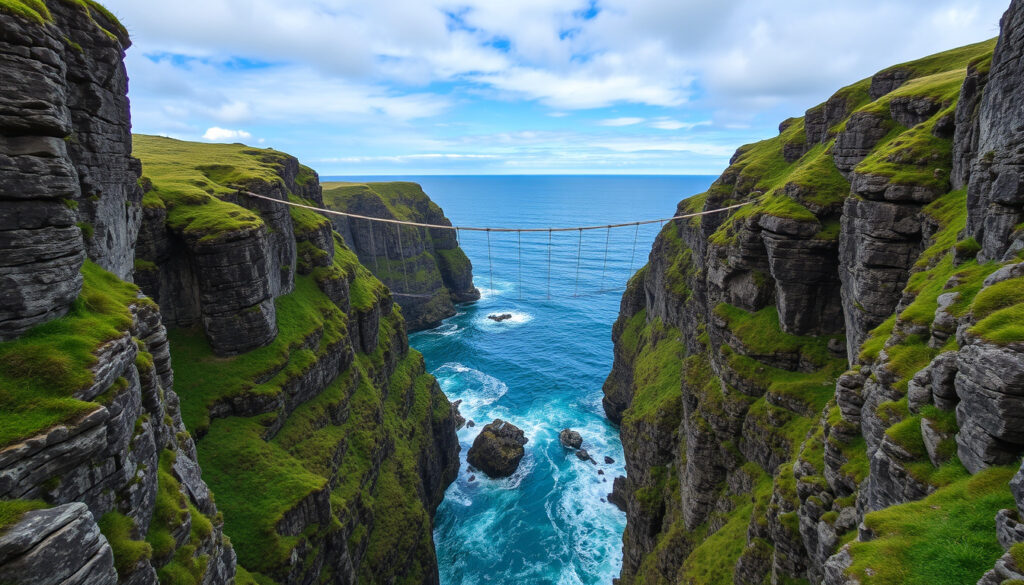
Carrick-a-Rede Rope Bridge – Complete Visitor Guide for 2025
Suspended 30 metres above the Atlantic Ocean, the Carrick-a-Rede rope bridge links the mainland near Ballintoy, County Antrim, to a small island that was once a seasonal outpost for salmon fishermen. Now managed by the National Trust, the bridge draws visitors from around the world who come for the coastal views, the crossing itself, and a sense of the region’s fishing heritage along the Causeway Coast.
Reaching the bridge requires a cliff-top walk of roughly 1.6 kilometres from the car park, and timed entry tickets are used to manage demand. The experience combines a short but memorable crossing with dramatic scenery, and understanding the practical details beforehand can make the difference between a smooth visit and a missed opportunity.
This guide covers the essential visitor information for 2025: how to book tickets, when to go, how to get there, what the walk involves, the site’s history, and what is known about safety and conditions.
How to Get Tickets for Carrick-a-Rede Rope Bridge
The National Trust operates a timed entry system for Carrick-a-Rede. Visitors are strongly advised to book online in advance, particularly during the summer months and on weekends, when slots can sell out well ahead of time. Online sales close one hour before each time slot.
Iconic 20-metre rope bridge suspended 30 metres above the Atlantic, linking the mainland to the small island of Carrick-a-Rede. Originally used by salmon fishermen since 1755.
Near Ballintoy, County Antrim, Northern Ireland. Postcode BT54 6LS. A 20-minute scenic cliff-top walk from the car park.
Managed by National Trust. Book online in peak season. Typical opening: March–October, 10am–6pm. Prices from £13 (adult, non-member).
Wear sturdy shoes, check weather forecast, allow 1–2 hours. Dogs on leads welcome. Photography permitted (no drones).
Key things to know about tickets include:
- The bridge was first erected by salmon fishermen in 1755 to access the island for net fishing.
- The name ‘Carrick-a-Rede’ comes from the Gaelic ‘Carraig-a-Rade’, meaning ‘The Rock in the Road’.
- Managed by the National Trust since the 1970s; modern safety upgrades include a mesh floor and handrails.
- Visitors must traverse a 1-mile (1.6 km) cliff path from the car park, offering stunning coastal views of the Causeway Coast.
- Weight limit is typically a maximum of 10 people on the bridge at any one time, with a wind-speed limit for closure.
- Peak visitor times are summer months; booking tickets in advance is strongly recommended to avoid disappointment.
- The bridge height varies with tides – approximately 30 metres above the water at high tide.
- Carrick-a-Rede is located on the UNESCO-recognised Causeway Coast, near other attractions like Giant’s Causeway and Bushmills Distillery.
| Fact | Value |
|---|---|
| Location | Ballintoy, County Antrim, Northern Ireland |
| Postcode | BT54 6LS |
| Managed by | National Trust |
| First built | 1755 (by salmon fishermen) |
| Bridge length | Approx. 20 metres |
| Bridge height | Approx. 30 metres above sea level |
| Weight limit | Max 10 people at a time |
| Walk from car park | 1 mile / 1.6 km (20 minutes one way) |
| Typical opening season | Mid-March to end of October |
| Typical opening hours | 10:00 – 18:00 (last entry 17:30) |
| Ticket price (adult non-member) | £13–£15 (2025 estimate) |
| National Trust members | Free entry (booking still required in peak) |
Pricing for non-members in 2025 is estimated at roughly £14–£15.50 for adults, £7–£7.75 for children, and around £35–£38.75 for family tickets, though exact figures are set annually by the National Trust. Members receive free access to most site elements but must still reserve a time slot. Tickets can be purchased through the National Trust ticketing portal.
Online ticket sales close one hour before each time slot. If you arrive without a booking during peak season, you may not get in. National Trust members still need to reserve a free time slot online.
What Are the Opening Times and Best Time to Visit?
The site typically opens from mid-March to the end of October, with hours generally running from 10:00 to 18:00 (last entry at 17:30). Some sources indicate the site may open as early as 9:00 or 9:30 a.m. depending on the season. Exact dates and hours vary each year and are confirmed on the official National Trust Carrick-a-Rede page.
Seasonal patterns and crowd levels
Summer brings longer daylight hours but also the largest crowds and busiest booking slots. Early morning and late afternoon are widely recommended by visitors for a quieter experience with better light for photography. Shoulder months such as April, May, September, and October offer a balance of decent weather and fewer visitors.
Weather and its effect on access
The bridge may close at short notice due to high winds or poor weather. There is no fixed wind-speed threshold published publicly, but the National Trust makes decisions on the day based on conditions. Checking the Met Office forecast for Northern Ireland before setting out is a practical step.
If you can be flexible, aim for a weekday in late April or early September. The weather is often mild, the paths are less crowded, and you will have more time on the bridge without feeling rushed.
How to Get to Carrick-a-Rede: Directions and Parking
Carrick-a-Rede is located at 119a Whitepark Road, Ballintoy, County Antrim, BT54 6LS. It sits on the Causeway Coastal Route, making it easy to combine with other major attractions such as the Giant’s Causeway and Bushmills Distillery.
By car
Driving times are roughly 10 minutes from Ballycastle and 20 minutes from Bushmills. The car park is managed by the National Trust, and parking is included in your ticket. Spaces fill quickly in peak season, so arriving early is advisable. National Trust members may park for free but still need to reserve a time slot.
On foot and public transport
The site lies on the Causeway Coast Way, a long-distance walking route. It is possible to walk from Ballycastle or Portrush, but this is a substantial hike and not recommended as a casual approach. Public transport options are limited; a car or taxi is the most practical option for most visitors.
What Is the Walk Like? Distance, Route, and Views
The walk from the car park to the bridge is roughly 1.3 to 1.6 kilometres each way and takes about 20 minutes at a steady pace. The path is a mix of gravel, steps, and steep sections, running along the cliff edge with panoramic views of the Atlantic and the coastline.
What to expect on the trail
- Gravel path with some uneven sections
- Steps and short steep inclines
- Cliff-edge viewpoints ideal for photography
- Exposure to coastal winds – hold onto hats and loose items
Most visitors should allow 1.5 to 2 hours total for a relaxed visit, including the walk, the bridge crossing, time for photos, and a look around the island. The bridge itself is about 20 metres long and the crossing takes only a few minutes, but the overall experience is about the setting as much as the bridge.
The path is not suitable for wheelchairs or pushchairs. Sturdy footwear with good grip is strongly recommended. The walk involves a steady descent to the bridge and a corresponding climb back, which some visitors find tiring.
Photography on and around the bridge
Photography is permitted and encouraged, but drones are prohibited for safety and conservation reasons. The best photo opportunities are from the cliff path approaching the bridge and from the island looking back towards the mainland. Early morning and late afternoon light are particularly favourable.
History of Carrick-a-Rede Rope Bridge: From Fishermen to Tourist Attraction
The bridge was first erected around 1755 by local salmon fishermen. They needed a way to reach Carrick-a-Rede Island to set and maintain their salmon nets, and a rope bridge provided the most practical access across the deep channel. The name ‘Carrick-a-Rede’ is thought to derive from the Gaelic ‘Carraig-a-Rade’, meaning ‘The Rock in the Road’.
The fishing heritage
For generations, the bridge was rebuilt each fishing season and taken down after the catch. It was a working tool rather than a tourist attraction. Salmon fishing on the north Antrim coast was a significant local industry, and the island’s location made it an ideal spot for netting fish as they migrated along the coast.
National Trust era and modernisation
The National Trust took over ownership and management of the site in the 1970s. Since then, the bridge has undergone several major refurbishments. Safety enhancements include a mesh floor, handrails on both sides, and strict weight limits. The current bridge is a modern replacement designed to withstand coastal conditions while preserving the character of the original.
How Has the Carrick-a-Rede Rope Bridge Changed Over Time?
- 1755 – First rope bridge erected by local salmon fishermen to reach the island for fishing nets.
- 19th century – Bridge rebuilt multiple times; used seasonally by fishermen.
- 1970s – National Trust takes over ownership and management of the site.
- 2000s – Major safety enhancements: mesh flooring, handrails, weight limits enforced.
- 2008 – Bridge closed temporarily due to structural concerns; reopened after repairs.
- 2013 – Bridge undergoes another refurbishment, including new ropes and planks.
- 2023 – Record visitor numbers; online ticketing system introduced.
- 2024–2025 – Continued maintenance; potential seasonal closures due to storm damage.
Is the Carrick-a-Rede Rope Bridge Safe? Weight Limit and Conditions
The bridge is well maintained and regularly inspected by the National Trust. It is considered safe for most visitors, but certain conditions apply. The maximum number of people allowed on the bridge at any one time is 10. The bridge may be closed in high winds or poor weather, though specific wind-speed thresholds are not published.
What is known and what remains uncertain
| Established information | Information that remains unclear |
|---|---|
| The bridge’s historical origin in 1755. | Exact daily closure times due to weather (wind, storms). |
| Current location and postcode (BT54 6LS). | Real-time ticket availability – subject to booking demand. |
| General opening season (March–October). | Future ticket price increases – check official site. |
| Weight limit of 10 people at once. | Occasional extended closures for maintenance (e.g., winter). |
| Managed by the National Trust. | Accuracy of third-party guide dates (e.g., ‘2026’ guides may be aspirational). |
| Ticket prices are confirmed annually by National Trust. | — |
Children and pets
Children can visit, but they should be comfortable with heights and closely supervised at all times. There is no minimum age, though the walk and the bridge itself may be daunting for very young children. Dogs on short leads are allowed on the trail and may be permitted on the bridge, though some dogs find the open sides frightening. It is advisable to confirm the current dog policy with staff on arrival.
Why Does Carrick-a-Rede Matter Beyond the Bridge Itself?
Carrick-a-Rede is one of several iconic attractions along the Causeway Coast, a UNESCO World Heritage Site. It is often combined with visits to the Giant’s Causeway (7 miles away) and the Old Bushmills Distillery. The bridge’s popularity has grown significantly in recent decades, leading to ticket quotas and timed entry to preserve both the visitor experience and safety.
Compared to other rope bridges globally, such as those in Nepal or Costa Rica, Carrick-a-Rede is relatively short and well-regulated, making it accessible to most visitors. The bridge’s story – from a fisherman’s utility to a National Trust tourist icon – reflects the broader shift in Northern Ireland’s economy towards tourism. Environmental factors such as coastal erosion and Atlantic storms pose ongoing challenges, and the National Trust regularly assesses structural integrity.
For those exploring the region, the The Ivy Belfast Menu offers a dining option in the city, while Things to Do in Budapest provides ideas for a city break further afield.
Which Sources Provide the Most Reliable Information?
The most authoritative source for current visitor information is the National Trust’s official Carrick-a-Rede page. The ticketing portal provides real-time availability and pricing. Wikipedia offers a well-cited overview of the bridge’s history and technical details, while Tourism Ireland’s site provides promotional context. Independent guides such as Northern Ireland Holidays offer practical tips but should be cross-checked against official sources for dates and prices.
“The famous Carrick-a-Rede rope bridge was first erected by salmon fishermen in 1755. The name, from the Gaelic ‘Carraig-a-Rade’, means ‘The Rock in the Road’.”
– National Trust official page
“Walk across a historic rope bridge, which was first erected by fishermen over 250 years ago, and take in the sights of the stunning Causeway Coast.”
– Ireland.com (Tourism Ireland)
“The Carrick-a-Rede Rope Bridge (locally pronounced carrick-a-reed) is a rope bridge near Ballintoy in County Antrim, Northern Ireland.”
– Wikipedia
For detailed historical and technical information, the Wikipedia article on Carrick-a-Rede Rope Bridge is a reliable reference. The Tourism Ireland page and the Northern Ireland Holidays guide offer additional visitor perspectives.
What Should You Know Before Planning Your Visit?
To make the most of a trip to Carrick-a-Rede, book tickets online in advance, check the weather forecast, allow at least 1.5 to 2 hours, wear sturdy footwear, and consider visiting in the shoulder seasons for a quieter experience. The bridge is typically closed from November to mid-March, so plan accordingly. Combining the visit with nearby attractions such as the Giant’s Causeway, Bushmills Distillery, and Dunluce Castle makes for a full day on the Causeway Coast.
Frequently Asked Questions
Can I take photos on the bridge?
Yes, photography is allowed and encouraged. However, drones are prohibited for safety and conservation reasons.
Is the bridge suitable for children?
Yes, but children must be supervised at all times. There is no minimum age, but the walk and bridge may be challenging for very young children.
Are dogs allowed on the bridge?
Dogs on short leads are allowed. Be aware of the open sides of the bridge; some dogs may find it frightening.
Is there parking at Carrick-a-Rede?
Yes, a car park is available. Parking is included in your ticket (or free for National Trust members). Spaces fill quickly in peak season.
What is the best time of day to visit?
Early morning or late afternoon to avoid crowds. Also check tide times if you want the bridge at its most dramatic height.
Can I visit in winter?
The bridge is typically closed from November to mid-March. Check the official National Trust page for exact dates.
Is the walk accessible for prams or wheelchairs?
The cliff path is gravel and uneven. It is not suitable for wheelchairs or pushchairs. There is a viewing point near the car park with limited views.
How deep is the water below?
The water depth varies with tides, but the bridge crosses a deep channel. Do not attempt to jump or climb from the bridge.
More related posts
 Joe Pesci – The Definitive 2025 Biography and Career Guide
 Ella Henderson – Biography, Songs, Net Worth & X Factor
 Deportivo Alavés vs Real Madrid Stats – Head-to-Head Breakdown
 B&Q Newtownabbey – Opening Hours, Address and Products
 How to Cook Kale – Simple Methods and Pro Tips
 Professor Alice Roberts – Age, Husband, Net Worth and 2026 Tour Facts
 Fighting with My Family – True Story, Cast, and Reviews
 Pictures of Cancerous Moles – Early Signs Identification Guide
