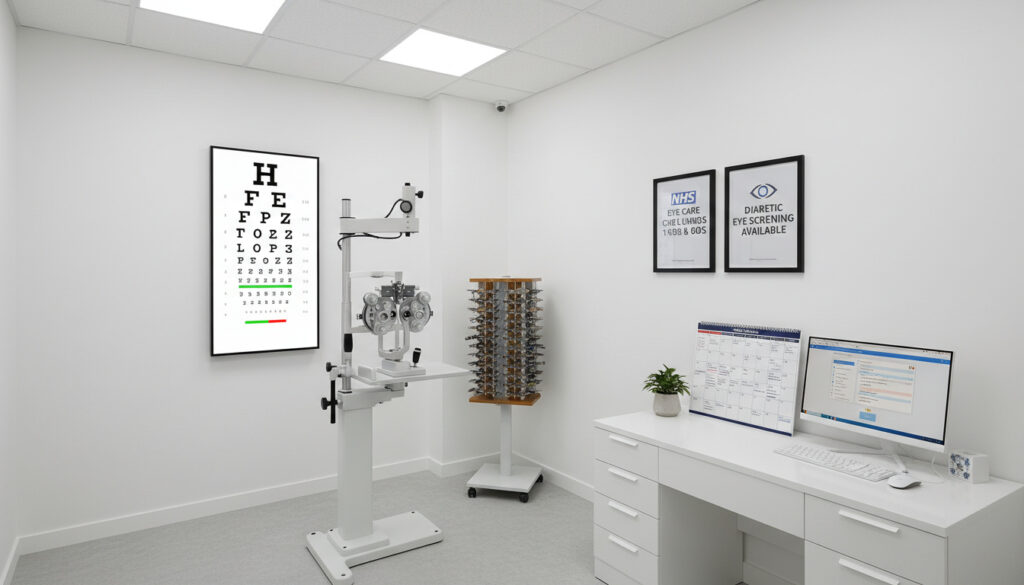
Eye Test Near Me – NHS Eligibility, Costs & Booking Guide
Locating an eye test near me remains a priority for millions of UK residents managing vision health, prescription updates, or routine screening. Whether seeking free NHS provision or private appointments, understanding local availability, costs, and eligibility requirements helps ensure timely access to optometric care across England, Wales, Scotland, and Northern Ireland.
High street chains and independent opticians now offer varied booking channels, from online portals to telephone scheduling, yet confusion persists regarding walk-in availability, pricing structures, and documentation requirements. The NHS funds sight tests for specific demographic and medical groups, while private fees typically range between £20 and £30 for those outside eligibility criteria.
Verifying your entitlement to free care and understanding the clinical procedures involved ensures informed decisions about your optical health.
How to Find an Eye Test Near Me
- Age-based eligibility: Residents under 16, students aged 16-18 in full-time education, and adults over 60 qualify automatically for free NHS sight tests in England.
- Benefits thresholds: Universal Credit recipients qualify if earning £435 or less monthly (without child or limited capability for work elements) or £935 or less (with these elements included).
- Medical conditions: Diagnosed diabetes, glaucoma, or registration as partially sighted/blind entitles patients to free examinations regardless of age.
- Proof requirements: Applicants must provide documentation such as benefit award notices, passports, or National Insurance numbers depending on their eligibility category.
- Geographic variations: Wales operates broader eligibility criteria than England, including provisions for urgent eye problems and specific ethnic backgrounds, while Scotland and Northern Ireland maintain separate NHS schemes.
- Provider landscape: Major chains including Specsavers and Vision Express dominate high streets, though independent practitioners offer comparable services in community settings.
- Cost assistance: NHS optical vouchers help cover glasses expenses for qualifying patients including under-19s in education and HC2 certificate holders.
| Fact Category | Specific Details |
|---|---|
| NHS Age Eligibility | Under 16; 16-18 in full-time education; 60 and over |
| Medical Qualifying Conditions | Diabetes, glaucoma, partial sight/blindness registration, 40+ with first-degree relative having glaucoma |
| Income-Based Qualification | Universal Credit (earnings ≤£435/£935), Income Support, income-related ESA/JSA, Pension Credit Guarantee Credit |
| Certificate-Based Access | Valid NHS tax credit exemption (income ≤£15,276), HC2 (full help), HC3 (partial help) |
| Non-Eligible Adult Cost | Typically £20-£30 at national chains; independents vary |
| Examination Duration | 20-40 minutes including health checks |
| Standard Recall Period | 24 months unless optician advises sooner |
| Required Documentation Examples | Benefit award notices, student cards, passports, driving licenses, NI numbers |
| Glasses Voucher Recipients | Under-16s, under-19s in education, certain benefit recipients, complex lens prescriptions |
| Booking Methods | Telephone, online appointment systems, limited emergency walk-ins |
What Is the Cost of an Eye Test?
NHS Free Eligibility Criteria
NHS-funded eye tests remain entirely free for patients meeting specific statutory criteria established by the NHS Business Services Authority. Eligibility extends beyond age to encompass those diagnosed with diabetes or glaucoma, individuals registered as blind or partially sighted, and patients over 40 with a first-degree relative diagnosed with glaucoma. Prisoners on temporary leave and those eligible for complex lens vouchers additionally qualify.
Income-related eligibility requires receipt of specific benefits with careful attention to earnings thresholds. For Universal Credit claimants, the monthly limit stands at £435 without child or limited capability for work elements, rising to £935 when these apply. Pension Credit Guarantee Credit and legacy benefits including income-based Jobseeker’s Allowance also confer eligibility.
Private Fees and Payment Structures
Adults not meeting NHS criteria typically encounter fees ranging from £20 to £30 at major optical chains, with independent practitioners setting similar or occasionally higher rates depending on location and examination complexity. Specsavers and Vision Express maintain transparent pricing structures available through their booking platforms.
Patients requiring examinations more frequently than the standard NHS two-year interval must usually bear these costs privately unless their optician certifies clinical necessity. HC3 certificate holders may receive partial NHS assistance toward private fees.
Financial Support for Optical Appliances
Beyond covering the examination itself, the NHS provides optical vouchers toward glasses or contact lens costs for qualifying individuals. These vouchers benefit children under 16, full-time students under 19, recipients of specific benefits, and patients requiring particularly complex prescriptions. The voucher value depends on prescription strength, with opticians calculating the precise contribution at the point of dispensing.
What Happens During an Eye Test?
The Five-Stage Examination Process
A comprehensive sight test follows a structured protocol lasting between 20 and 40 minutes. The examination begins with a detailed history taking, where the optometrist discusses current vision concerns, general health status, family medical history, and any symptoms such as headaches or eye strain.
Visual acuity testing follows, typically using a Snellen chart or automated equivalent to measure sharpness at varying distances. Refraction testing determines precise lens prescriptions through trial lenses or autorefractor machines. Critical health assessments include intraocular pressure measurements to screen for glaucoma and fundus examination evaluating retinal health, optic nerve appearance, and blood vessel condition. Field of vision testing may supplement these checks where indicated.
The consultation concludes with professional advice regarding corrective lenses, follow-up intervals, or referrals to ophthalmology services if pathology such as cataracts or diabetic retinopathy requires specialist intervention.
Duration and Time Commitment
Standard appointments require 20-40 minutes, though complex cases or first-time examinations may extend longer. Patients should arrive five to ten minutes early to complete registration forms or update contact details.
Documents to Bring to Your Appointment
Eligibility verification demands specific documentation varying by category. Adults over 60 should bring identification containing their National Insurance number, passport, or driving license. Benefit recipients must present award notices or exemption certificates. Those qualifying through medical conditions should provide their GP details or specialist correspondence.
Bring your current glasses or contact lenses and a list of any medications you take. Contact lens wearers may need to remove lenses several hours before the examination depending on the type, so verify requirements when booking.
How Often Should I Have an Eye Test?
Standard Two-Year Intervals
For most adults, opticians recommend routine examinations every two years. This frequency applies regardless of whether patients require vision correction, as asymptomatic conditions including glaucoma and diabetic eye disease often develop without noticeable early warning signs.
High-risk groups require more frequent monitoring. Adults over 40 with a family history of glaucoma should undergo annual testing. Patients diagnosed with diabetes typically require yearly retinal screening through dedicated NHS diabetic eye programmes, supplementary to standard optometric care.
Booking Your Local Appointment
Appointments are secured directly through optician practices via telephone or online booking systems. The NHS App and NHS website provide directories of local providers accepting NHS patients. Chains generally offer broader geographic coverage with standardized pricing, while independent practices may provide extended appointment durations and personalized service continuity.
Most major chains now offer real-time availability calendars allowing same-day or next-day bookings. Search “eye test near me” via Google Maps or the NHS website to locate registered providers within your postcode.
Walk-In versus Scheduled Care
Routine NHS eye tests require appointments; walk-in availability remains limited to emergency situations such as sudden vision loss, severe eye pain, or trauma. Private practices occasionally accommodate walk-in eye examinations, though scheduling guarantees timely service and reduces waiting periods.
If you are over 40 with a parent, sibling, or child diagnosed with glaucoma, or if an ophthalmologist has advised you are at risk of glaucoma, you qualify for free annual NHS sight tests rather than the standard two-year interval.
Recommended Eye Test Intervals Through Life
- Childhood (Ages 0-16): Every two years minimum, free under NHS. Children under 16 require no proof of eligibility; those 16-18 must verify full-time education status.
- Adulthood (Ages 16-60): Every two years unless experiencing symptoms such as persistent headaches, floaters, or blurred vision. Private costs apply unless qualifying through benefits or medical conditions.
- Senior Years (Age 60+): Free NHS examinations every two years. Proof of age or National Insurance number required at first appointment.
- High-Risk Monitoring (Age 40+): Annual testing recommended for those with first-degree relatives affected by glaucoma, plus free under NHS.
Separating Fact from Fiction: Eye Test Myths
| Myth | Established Fact |
| Everyone in the UK receives free NHS eye tests | Only specific age groups, benefit recipients, and those with qualifying medical conditions receive free NHS sight tests in England. Others pay private fees typically between £20-£30. |
| No documentation is required at your appointment | Proof is often mandatory depending on eligibility category. Benefit recipients must bring award notices or certificates, while students require identification verifying full-time education status. |
| Annual examinations are standard for all adults | The standard NHS recall interval is every two years. Annual testing applies only to specific clinical risk groups or at the optician’s discretion. |
| Walk-in appointments are always available | While some practices accommodate urgent walk-ins, routine examinations require advance appointments. Major chains and independents prefer scheduled bookings to ensure adequate examination time. |
The Broader Health Implications of Regular Testing
Comprehensive eye examinations detect systemic health conditions beyond refractive errors. Optometrists regularly identify signs of diabetes through retinal changes, hypertension via blood vessel abnormalities, and neurological conditions through field defects. B&Q Chester – Address, Hours and Contact Guide provides location details for nearby services, though for optical care, dedicated eye health providers remain the appropriate choice.
The NHS and professional bodies including the Association of Optometrists emphasize that asymptomatic screening prevents avoidable sight loss. Diabetic retinopathy, glaucoma, and age-related macular degeneration often progress silently until irreversible damage occurs, reinforcing the value of biennial examinations even when vision appears stable.
Professional Guidance on Eye Care
Eligibility for NHS-funded sight tests extends to specific medical conditions including diagnosed diabetes and glaucoma, as well as individuals aged 40 or over who are the parent, sibling, or child of a person diagnosed with glaucoma.
Wales operates broader eligibility criteria compared to England, including provisions for urgent eye problems, individuals with sight in one eye only, and those from Black or Asian ethnic backgrounds.
Key Takeaways for Booking Your Local Eye Test
Securing an eye test near me requires verifying your NHS eligibility status, gathering appropriate documentation, and selecting between high street chains offering standardized £20-£30 examinations or independent practitioners providing personalized care. Book appointments via telephone or online platforms, attend every two years as standard, and understand that free NHS provision covers specific age groups, medical conditions, and benefit recipients. For further reading on navigating local services and health-related inquiries, see Take Care of Maya – True Story, Verdict and Timeline.
Frequently Asked Questions
Can I get an eye test without insurance?
Yes. The UK does not require insurance for eye examinations. NHS-eligible patients receive free tests, while others pay privately, typically £20-£30 at major chains.
How to book an eye test near me online?
Visit the websites of major providers like Specsavers or Vision Express, enter your postcode in their store finder, select an available time slot, and provide basic contact information. Alternatively, use the NHS App to locate registered providers.
Are walk-in eye tests available near me?
Routine NHS eye tests require appointments. Some private practices accept walk-ins for urgent issues, but scheduling ahead guarantees service availability and reduces waiting times.
How do I know if I’m eligible for a free NHS test?
You qualify if you are under 16, 16-18 in full-time education, over 60, diagnosed with diabetes or glaucoma, registered blind/partially sighted, or receive specific benefits including Universal Credit within earnings thresholds.
What proof do I need to bring for a free eye test?
Requirements vary by category: over-60s need ID with NI number; benefit recipients need award notices or HC2/HC3 certificates; students need proof of full-time education; those qualifying via medical conditions need GP details.
Can I get free glasses with my NHS eye test?
The examination itself is free for eligible patients. Separate NHS optical vouchers toward glasses costs are available for under-16s, under-19s in education, certain benefit recipients, and those with complex prescriptions.
How long does an eye test take?
Standard examinations last 20-40 minutes, including history taking, vision testing, prescription checks, and eye health assessments for pressure and retinal condition.
More related posts
 How to Clean Washing Machine – Complete UK Guide with Step-by-Step Methods
 Theatre Royal Drury Lane – Seating Plan Best Seats Guide
 Deportivo Alavés vs Real Madrid Stats – Head-to-Head Breakdown
 Professor Alice Roberts – Age, Husband, Net Worth and 2026 Tour Facts
 Weather Newcastle Co Down – Hourly & 7-14 Day Forecast
 Jason Momoa – Height, Net Worth, Movies and Personal Life
 Oxford Instruments Share Price – Latest LSE Data and Analysis
 Things to Do in Budapest – Ultimate 2025 Travel Guide
