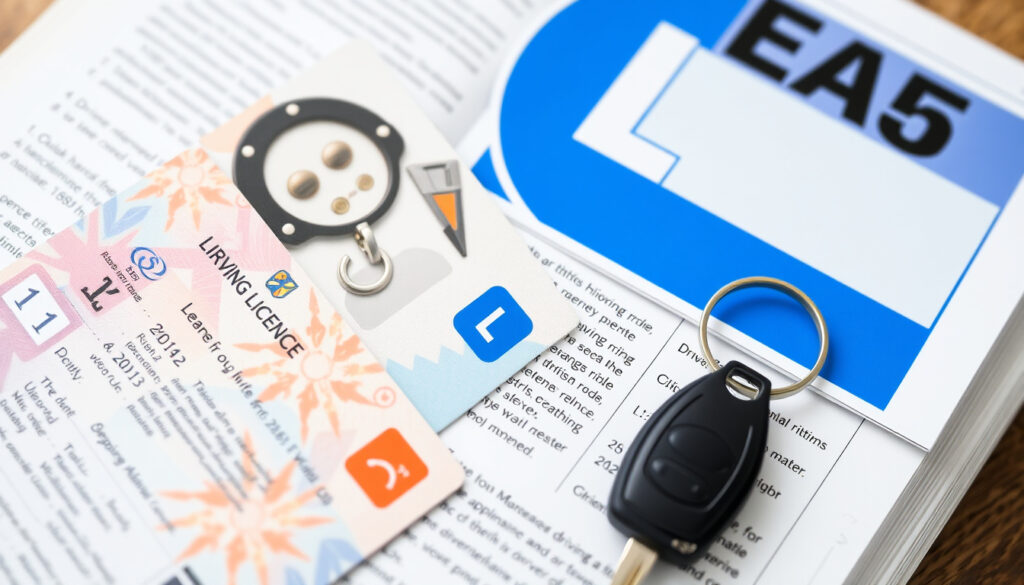
UK Driving Licence Rules 2025 – Over 70s and Learner Guide
A series of changes to UK driving licence rules are being introduced between 2025 and 2026, affecting older drivers, learner drivers, and all motorists. While some measures are now confirmed, many remain under consultation or are still proposals. The most searched topic concerns drivers aged 70 and over, where stricter renewal procedures and mandatory eye tests are under active discussion.
Drivers over 70 must already renew their licence every three years and self-declare their fitness to drive. The current requirement does not include a mandatory eye test, but that may change. The Driver and Vehicle Licensing Agency (DVLA) is also enforcing renewal deadlines more strictly. According to a YouTube analysis of DVLA behaviour, failing to renew on time can result in the slot expiring and the driver having to submit a full new application.
The DVLA has been criticised for queue‑based renewal processes where delays can “kick you to the back.” Drivers over 70 should allow extra time for processing and not leave renewal until the last minute.
Overview of key changes for older drivers
- Licence renewal every 3 years remains mandatory for over 70s.
- Proposed mandatory eye test at renewal – under review as part of the 2026 road safety strategy.
- Stricter enforcement by DVLA – failure to renew on time may require full reapplication.
- No re‑test is proposed; only a potential eye test.
Key insights about the proposed changes
- Driving licence changes for over 70s are the most searched topic in this space, with potential mandatory eye tests driving the conversation.
- The minimum learning period for learner drivers is a major proposed change, currently in public consultation.
- Many changes are still proposals (2025–2026) – clarity on which are confirmed vs. under review is critical for users.
- Combining older driver, learner, and general law updates into one guide fills a clear gap in the current search results.
- Seatbelt law updates and lower drink‑drive limits are also under consideration but not yet enacted.
- The phrase “7 new driving rules” appears to be a simplified media grouping; no official document lists exactly seven rules.
Snapshot: Key facts and dates
| Topic | Current situation | Proposed or confirmed change |
|---|---|---|
| Minimum age to drive a car | 17 | No change proposed |
| Minimum learning period (learner drivers) | No minimum | 12 months proposed; 6 months confirmed in Northern Ireland (from October 2026) |
| Over 70s licence renewal | Every 3 years, self‑declare fitness | Mandatory eye test under review |
| Drink‑drive limit (England/Wales) | 80mg/100ml blood | Possible reduction to 50mg/100ml proposed |
| Seatbelt rules | Must be worn by drivers and passengers | May extend to all passengers including taxis and private hire vehicles |
| Car training codes | No formal post‑test framework | New framework expected 2025–2026 |
| Driving test booking changes | Up to 6 changes allowed; instructors could book | Only 2 changes; only the learner can book (from spring 2026) |
| Graduated driver licensing (NI) | No formal system | Introduced 1 October 2026 with restrictions for under‑24s |
| Fuel duty | Current rate | +1p/litre from September 2026 |
| EV congestion charge exemption (London) | Exempt | Exemption lost January 2026; charge rises from £15 to £18 |
| Points system | Minor offences (e.g. phone use, amber light roll) – points as set | Overhaul proposed – minor offence points may double |
| Driving without a licence | Fine up to £1,000, penalty points, or disqualification | Penalties may increase under future changes |
What is the minimum learning period for learner drivers and what driving test changes are coming?
The most significant proposal for learner drivers is the introduction of a mandatory minimum learning period. Under a UK‑wide consultation, drivers would have to hold a provisional licence for at least 12 months before taking their practical test. In Northern Ireland, a graduated driver licensing (GDL) scheme is already confirmed and will begin on 1 October 2026, requiring a minimum of 6 months of learning.
Minimum learning period
The UK government opened a public consultation on a minimum learning period for category B (car) driving licences. The proposed 12‑month period is designed to ensure learners gain sufficient practice before being tested alone. In Northern Ireland, the GDL framework mandates a 6‑month minimum, along with a logged training programme in a logbook. Both measures aim to reduce post‑test crash rates among newly qualified drivers.
If the 12‑month proposal becomes law UK‑wide, learners will need to plan their training well ahead. The consultation period runs through 2025, with possible legislation in 2026. In Northern Ireland, the 6‑month rule is already fixed for October 2026.
New driving test rules (2026)
From spring 2026, major restrictions will apply to car driving test bookings, as confirmed by GOV.UK. Key changes:
- Only 2 changes allowed per booking (previously up to 6). Exceeding requires full cancellation and 10 working days’ notice for a refund.
- Only the learner driver can book, change, or cancel a test. Driving instructors and third parties cannot do so from 12 May 2026.
- Test centre relocation can only be to one of the three nearest centres from 9 June 2026.
The new rules aim to combat high cancellation rates and administrative abuse. Learners must manage their own bookings. UK Driving Rules and Licence Changes: 2025-2026 Updates provides a full overview of all timelines.
New rules for new drivers (graduated driver licensing)
Northern Ireland’s GDL scheme introduces the following for drivers under 24 from October 2026:
- Post‑test ‘R’ plate for 24 months (up from 12), allowing motorway driving up to the speed limit.
- Night‑time driving restrictions for the first 6 months (under‑24s).
- Passenger limits for new drivers under 24 (family members exempt).
UK‑wide proposals mirror these measures, with discussions ongoing. Confused.com and other insurers have flagged that similar restrictions could be introduced across England, Wales, and Scotland.
Car training codes and driving test updates
Under the NI GDL, structured logbook training is mandatory before taking the practical test. Theory test content is also being updated – Ageas reports that CPR and first aid questions will be added. The term “car training codes” refers to a new post‑test training framework expected to be rolled out in 2025–2026, though details remain limited.
What are the 7 new driving rules and other UK law changes in 2025?
There is no single official document listing exactly seven rules. The phrase likely refers to a collection of proposed and confirmed changes grouped by media outlets. Based on reliable sources, the expected updates cover drink‑driving, seatbelts, penalties, and enforcement.
Drink‑drive limits
Discussions are under way to lower the drink‑drive limit in England and Wales from the current 80mg of alcohol per 100ml of blood to 50mg. A lower limit is already in place in Scotland. Nationwide Vehicle Contracts includes this in its list of six new driving laws for 2026. Admiral also confirms it is part of the 2026 safety strategy. Additionally, alcolocks (ignition interlock devices) are proposed as mandatory for convicted drink‑drivers.
Seatbelt law changes
Penalties for failing to wear a seatbelt are expected to become tougher. The current law requires seatbelts to be worn by drivers and passengers over 14. Proposals could extend the requirement to all passengers, including those in taxis and private hire vehicles.
Penalties for driving without a licence in 2026
Driving without a valid licence can currently result in a fine of up to £1,000, penalty points, or disqualification. Under future changes, penalties may increase. Tougher enforcement against uninsured drivers is also planned, with increased use of automatic number plate recognition (ANPR) checks.
Minor offences such as using a phone while driving or rolling through an amber light could see doubled penalty points under a proposed overhaul of the points system. This is not yet confirmed.
Timeline – When do the changes take effect?
- January 2026: Electric vehicles lose London congestion charge exemption; charge rises from £15 to £18.
- 31 March 2026: Driving test changes limit number of changes per booking to 2.
- 12 May 2026: Only learner drivers can book or manage their own test – instructors and third parties barred.
- 9 June 2026: Test centre relocations restricted to the three nearest centres.
- 1 October 2026: Graduated driver licensing begins in Northern Ireland (minimum learning period, night‑time and passenger restrictions).
- September 2026: Fuel duty increases by 1p per litre.
- 2025–2026 (consultation period): UK‑wide minimum learning period for learner drivers (12‑month proposal) – legislation may follow in 2026.
- 2026 (proposed): Mandatory eye tests for over‑70s at licence renewal – no exact date set.
- 2026 (proposed): Lower drink‑drive limit in England/Wales – under discussion; no date confirmed.
- 2025–2026: Car training codes and updated theory test (including first aid/CPR) – phased introduction.
Proposed vs. confirmed – What you need to know
| Established information | Information that remains unclear |
|---|---|
| Driving test booking restrictions are confirmed for spring 2026 (GOV.UK). | Exact date for mandatory eye tests for over‑70s is not set. |
| Northern Ireland GDL is confirmed for 1 October 2026. | UK‑wide minimum learning period (12 months) is still under consultation. |
| EV congestion charge exemption ends January 2026. | Drink‑drive limit reduction is proposed but not yet law. |
| Fuel duty increase of 1p/litre from September 2026 is confirmed. | Seatbelt law extension to all taxi passengers is not yet enacted. |
| Points system overhaul is under discussion – no final decision. | The phrase “7 new driving rules” is a media grouping, not an official list. |
Why are these changes being introduced?
Road safety statistics show that older drivers are involved in fewer collisions per mile driven, but age‑related vision decline remains a concern. Research indicates that learner drivers who spend a longer period practising before taking their test have lower crash rates after passing. Drink‑driving deaths continue to be a significant issue, prompting calls for lower limits and alcolock devices. These proposals aim to reduce casualties across all age groups and modernise the licensing system to reflect current road use patterns.
The driving test booking changes address widespread abuse of the system, with some candidates making multiple cancellations and others using third‑party bookers to jump the queue. By limiting changes and requiring learners to manage their own bookings, the Driver and Vehicle Standards Agency (DVSA) hopes to improve availability and reduce waste.
What are the official sources for these changes?
The information in this guide is drawn from official government documents and reputable UK organisations. Key sources include: For further details on the UK driving licence rules, you can refer to $Sean Combs net worth legal case.
“Introducing a minimum learning period for learner drivers” – GOV.UK consultation document
“Driving licences for the over‑70s” – House of Commons Library research briefing
“Changes to driving test booking rules in 2026” – GOV.UK guidance
Further context is provided by Infrastructure NI (GDL details), Ageas, Admiral, and Nationwide Vehicle Contracts. For the latest updates, always check GOV.UK consultations and the Royal Society for the Prevention of Accidents (RoSPA).
For a detailed breakdown of the test booking rules, see Changes to Driving Test Booking Rules in 2026.
What should drivers do next?
Drivers should monitor the outcome of the minimum learning period consultation, expected in mid‑2025. Watch for parliamentary debate on older driver eye tests – a bill may be introduced in 2025/26. Check DVSA and Think! for official updates on drink‑drive and seatbelt legislation. Over‑70s should plan renewal well in advance to avoid processing delays.
Frequently asked questions
What are the penalties for driving without a licence in 2026?
Driving without a valid licence can result in a fine up to £1,000, penalty points, or disqualification. Penalties may increase under future changes, but no new figure has been confirmed.
Is the minimum learning period already in effect?
No, it is still a proposal under consultation. It is not yet law in most of the UK. Northern Ireland has a 6‑month minimum confirmed for October 2026.
Do over 70s need to take a driving test again?
No. Over 70s only need to renew their licence every three years and self‑declare fitness. No re‑test is proposed – only a potential eye test.
When do the new driving test booking rules start?
Restrictions on changes begin 31 March 2026. From 12 May 2026 only the learner can book or manage the test. Relocation restrictions start 9 June 2026.
Will drink‑drive limits definitely be lowered?
A reduction from 80mg to 50mg is proposed but not yet confirmed. Discussions are ongoing as part of the 2026 road safety strategy.
What is a car training code?
Car training codes refer to a new framework for post‑test training expected to be introduced in 2025–2026. Details are still being developed.
Are there restrictions for new drivers under 24 in the UK?
Yes, in Northern Ireland from October 2026. UK‑wide proposals are under discussion but not yet confirmed.
Will seatbelt rules change in 2025?
Penalties for not wearing a seatbelt are expected to become tougher. The law may be extended to include all passengers, including those in taxis.
How do I renew my driving licence if I’m over 70?
Renew online via GOV.UK. You must self‑declare your fitness. From 2026, a mandatory eye test may be required – check official updates.
What are the main 2026 changes for electric vehicles?
Electric vehicles lose their London congestion charge exemption from January 2026, and the daily charge rises from £15 to £18. Fuel duty also increases by 1p per litre from September.
More related posts
 How Old Is Lando Norris – Complete Age and Career Guide
 Jason Momoa – Height, Net Worth, Movies and Personal Life
 Rory McIlroy – Net Worth, Bio, Wife and Major Wins in 2026
 Killian Scott – Biography, Partner, Height & Career Facts
 Drop Dead Fred – Cast, Streaming & Sequel Rumors
 Melania Trump Model Photos – Career Guide and Iconic Shoots
 Danniella Westbrook – Addiction, Face Surgery & Life Now
 Ray Kroc – Biography, Net Worth, and the Full Story
