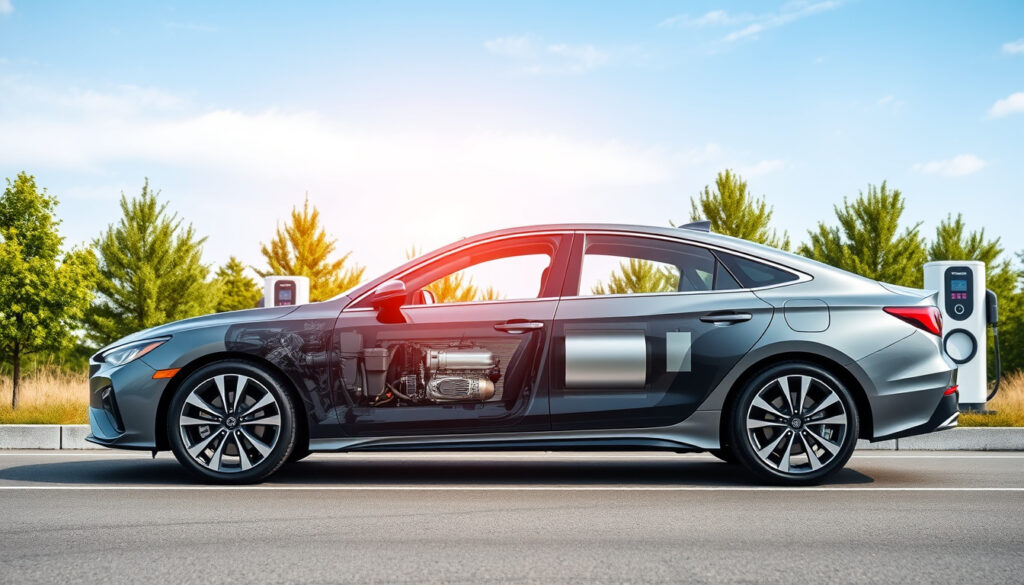
What Is a Hybrid Car – How It Works, Types, Pros and Cons
A hybrid car combines a conventional internal combustion engine—usually a petrol-powered unit—with an electric motor and a battery pack. Unlike a purely electric vehicle, it does not require external charging to replenish its battery; the energy is captured through regenerative braking and, in some configurations, from the engine itself. Hybrids aim to reduce fuel consumption and lower tailpipe emissions compared with standard petrol or diesel cars, while avoiding the range limitations of battery-electric vehicles.
The basic concept is straightforward: two power sources work together to move the car. The petrol engine provides power at higher speeds or under heavy load, while the electric motor handles low-speed driving and assists during acceleration. A computer constantly decides which combination is most efficient, without any input from the driver. This seamless switching is what makes hybrids feel familiar yet noticeably more economical.
Regenerative braking is a key feature. When the driver lifts off the accelerator or applies the brakes, the electric motor reverses its role and acts as a generator, converting kinetic energy into electricity that is stored in the battery. This not only recharges the battery but also reduces wear on the conventional friction brakes.
How Does a Hybrid Car Work?
| Definition A hybrid car uses two energy sources: a petrol or diesel engine and an electric motor powered by a battery. |
How It Works The engine and motor work together automatically. Regenerative braking recaptures energy to charge the battery. |
| Main Types Mild hybrid, full hybrid (HEV), plug-in hybrid (PHEV), and range-extender hybrid. |
Key Pros & Cons Better fuel economy and lower emissions vs. higher purchase price and battery replacement concerns. |
Key Insights
- Hybrids combine a petrol/diesel engine with an electric motor to improve fuel economy by 20–35% over conventional petrol cars.
- Plug-in hybrids (PHEVs) can run on electric power alone for 20–50 miles before the petrol engine kicks in.
- Mild hybrids use a small electric motor to assist the engine but cannot drive on electricity alone.
- Toyota pioneered the mass-market hybrid with the Prius in 1997, and its Hybrid Synergy Drive system remains one of the most common.
- Hybrids produce lower CO₂ emissions than conventional cars but still rely on fossil fuels and are not zero-emission.
- Battery replacement cost is a common concern, though manufacturer warranties often cover 8–10 years.
Fact Snapshot: Hybrid Car Performance
| Metric | Typical Value |
|---|---|
| Fuel economy improvement | 20–35% over conventional petrol |
| Electric-only range (PHEV) | Up to 50 miles (WLTP) |
| Battery capacity (typical) | 1.5 kWh (mild) to 10–18 kWh (PHEV) |
| CO₂ emissions (WLTP) | From ~80 g/km (PHEV) to ~120 g/km (full hybrid) |
| Average price (UK 2025) | £25,000–£45,000 (compact to SUV) |
What Are the Advantages and Disadvantages of a Hybrid Car?
Advantages
Better fuel economy is the most immediate benefit. For example, a 2022 Toyota Corolla Hybrid averages about 52 MPG combined, compared with roughly 34 MPG for the conventional Corolla. Real-world figures for the Prius often fall between 40 and 55 MPG. This efficiency also means fewer stops at the petrol station—many hybrids can travel 300–500 miles on a single tank.
Hybrids have shown greater reliability than their petrol-only counterparts. Consumer Reports data indicate that hybrids experience about 15% fewer problems on average. Reduced wear on brake pads, thanks to regenerative braking, and the absence of traditional starters and alternators in some designs contribute to lower maintenance costs.
Disadvantages
Higher upfront cost remains the primary drawback. A new hybrid typically costs £300–£800 more than a comparable petrol car. Plug-in hybrids can cost £1,300–£14,000 more, depending on the model. Battery replacement outside the warranty period can be expensive, though warranties often cover eight to ten years.
For traditional HEVs, electric-only range is limited to low speeds and short distances. Plug-in hybrids deliver full fuel savings only if the owner commits to regular charging. And unlike battery-electric vehicles, every hybrid still requires trips to the petrol station.
The payback period for the higher purchase price depends heavily on driving habits. City-heavy driving maximises the benefit because the electric motor handles stop-and-go traffic efficiently. On motorways, hybrids tend to rely more on the petrol engine, reducing the fuel economy advantage.
What Types of Hybrid Cars Are There?
Full Hybrid (HEV)
A full hybrid can run on petrol, electric power, or both together. It uses a larger battery and a more powerful electric motor than a mild hybrid. The Toyota Prius and Corolla Hybrid are classic examples. These cars can travel short distances at low speed on electricity alone, and the engine automatically shuts off at stops to save fuel.
Mild Hybrid (MHEV)
A mild hybrid uses a small electric motor (often a 48-volt system) to assist the petrol engine during acceleration and to restart the engine after stopping. It cannot drive the wheels on electricity alone. Fuel economy improves modestly, typically by 10–15%, but the system is cheaper to implement.
Plug-In Hybrid (PHEV)
Plug-in hybrids have a much larger battery than a standard HEV and can be charged from an external power source. They offer 20–60 miles of all-electric range, after which the petrol engine takes over. The Toyota RAV4 Prime and Chrysler Pacifica Hybrid are popular PHEVs. Plugging in regularly is essential to realise the full fuel savings.
Toyota Hybrid Synergy Drive
Toyota’s proprietary system, known as Hybrid Synergy Drive, uses a planetary gear set to blend power from the petrol engine and two electric motors. It operates as a parallel–power‑split hybrid, combining elements of series and parallel architectures. There is no traditional transmission; power delivery is continuously variable, giving a smooth, CVT-like feel. This system allows electric-only driving at low speeds and combined power for acceleration, while regenerative braking helps extend brake life.
Toyota hybrids have a strong reputation for durability. Many examples have exceeded 200,000 miles on the original battery, and the company offers an 8‑year/100,000‑mile warranty on hybrid components in many markets.
Is a Hybrid Car an Electric Car?
No, a hybrid car is not classified as a pure electric vehicle. A battery-electric car (EV) relies solely on electricity stored in a large battery pack and must be plugged in to recharge. A standard hybrid (HEV) never needs to be plugged in; its battery is charged by the petrol engine and regenerative braking. Plug-in hybrids (PHEVs) can be plugged in, but they still carry an internal combustion engine and can run on petrol.
The key distinction is that hybrids still emit tailpipe CO₂ when the petrol engine is running, whereas EVs produce no tailpipe emissions. Hybrids also have shorter electric-only ranges and depend on a fossil fuel source. However, hybrids offer a familiar refuelling experience and do not require access to charging infrastructure, which can be a practical advantage for many buyers.
It is a common misconception that all hybrids must be plugged in. Full hybrids (HEVs) and mild hybrids (MHEVs) recharge their batteries automatically through regenerative braking and engine power. Only plug-in hybrids (PHEVs) benefit from external charging.
How Much Does a Hybrid Car Cost?
The purchase price of a hybrid varies by type and model. Standard full hybrids typically cost £300–£800 more than their petrol-only equivalents. Plug-in hybrids represent a larger step, often £1,300–£14,000 more than a comparable petrol car. However, UK government incentives, such as lower Vehicle Excise Duty and Benefit-in-Kind rates for company car drivers, can reduce the effective cost over time.
Running costs are generally lower. Fuel savings can offset the premium, especially for drivers who cover many urban miles. Maintenance is often cheaper because regenerative braking reduces brake pad wear and some components (like alternators) are absent. Battery replacement, while infrequent, remains a potential long-term expense.
For context, a typical compact hybrid SUV in the UK sits in the £30,000–£45,000 range, while a small hatchback hybrid may start around £25,000. Prices continue to shift as battery technology matures and production scales.
Key Milestones in Hybrid Car Development
- 1997 – Toyota launches the first mass‑produced hybrid, the Prius, in Japan.
- 2000 – The Honda Insight hybrid is introduced in the US and Europe.
- 2003 – The second‑generation Toyota Prius achieves widespread popularity.
- 2010 – The first plug‑in hybrids, including the Chevrolet Volt and Toyota Prius Plug‑in, reach the market.
- 2012 – Mild hybrid systems, such as Honda’s IMA, become common in many models.
- 2020–2025 – Hybrid sales surge globally as manufacturers increasingly offer hybrid versions of popular models as a stepping stone toward full electrification.
What Is Certain and Uncertain About Hybrid Cars?
| Established information | Uncertainty areas |
|---|---|
| Hybrids reduce fuel consumption and emissions compared with conventional petrol cars. | Long‑term battery replacement costs and reliability beyond 10 years are not fully established. |
| There are distinct types: mild, full, plug‑in (PHEV), and range‑extender hybrids. | Whether hybrids will remain a mainstream choice as EV charging infrastructure expands is uncertain. |
| All hybrids rely on regenerative braking to recharge the battery. | Real‑world fuel economy varies significantly with driving style, traffic conditions, and climate. |
Why Hybrid Cars Matter in Today’s Market
Hybrids serve as a bridge between conventional internal combustion vehicles and full battery‑electric cars. They reduce tailpipe CO₂ emissions while avoiding the range anxiety and charging‑infrastructure limitations that still affect many EV buyers. Many governments, including the UK, plan to phase out new petrol and diesel cars by 2030–2035, but hybrids—especially plug‑in models—are expected to remain available for some years beyond that.
From a financial perspective, hybrids benefit from lower tax bands in the UK, including reduced Vehicle Excise Duty and favourable Benefit‑in‑Kind rates for company car drivers. The environmental impact is meaningful: even without plugging in, a standard hybrid cuts CO₂ output by 20–35% compared with a similar petrol car. For buyers who cannot install a home charger or need to make long journeys regularly, a hybrid offers a practical compromise.
Expert Sources on Hybrid Cars
“A hybrid car is a vehicle that typically combines a conventional combustion engine (usually petrol-powered) with an electric motor.”
– RAC, What is a Hybrid?
“A hybrid car is great fun to drive. Thanks to the electric motor, hybrids tend to pull away quieter.”
– Renault Blog, Hybrid Pros and Cons
“A hybrid vehicle is one that uses two or more distinct types of power.”
– Wikipedia, Hybrid vehicle
“It’s any car that pairs an electric motor with a petrol or diesel engine.”
– Evans Halshaw, Difference Between Full, Mild and Plug-In Hybrid
“A hybrid car is powered by two different sources: an internal combustion engine, and a battery and an electric motor.”
– Carwow, What is a Hybrid Car?
The Future of Hybrid Cars
Hybrid technology is expected to evolve as a stepping stone to full electrification. Improved battery chemistry, longer electric‑only ranges, and more affordable plug‑in hybrids are likely to appear. At the same time, government policies may accelerate the shift to battery‑electric vehicles, potentially reducing hybrid market share after 2030. For now, hybrids remain a practical and increasingly popular choice for drivers who want lower emissions without the need for charging infrastructure. For more context on the wider EV ecosystem, see EV Charging Stations Near Me – Live Maps and Fast UK Options.
Frequently Asked Questions
Do hybrid cars need to be plugged in?
Standard hybrids (HEV) and mild hybrids (MHEV) do not need to be plugged in. Only plug‑in hybrids (PHEV) require external charging to deliver their full electric range.
What is the difference between a hybrid and an electric car?
An electric car runs solely on battery power and must be charged. A hybrid has both a petrol engine and an electric motor; it can still operate on petrol alone.
Are hybrid cars more expensive to maintain?
Hybrids often cost less to maintain because regenerative braking reduces brake wear and they lack some conventional components like alternators. Battery replacement can be costly but is rare.
How long do hybrid batteries last?
Most manufacturers offer an 8‑year/100,000‑mile warranty on hybrid batteries. Many owners report batteries lasting 150,000 miles or more in real‑world use.
Is a hybrid car good for city driving?
Yes. Hybrids are particularly efficient in stop‑and‑go traffic because the electric motor handles low‑speed driving and regenerative braking captures energy from frequent braking.
Are hybrids good for long motorway trips?
Hybrids can handle motorway driving, but the fuel economy advantage is smaller because the petrol engine runs more often. Plug‑in hybrids offer the best long‑distance efficiency if the battery is kept charged.
What is a Toyota hybrid?
A Toyota hybrid uses the brand’s Hybrid Synergy Drive, which combines a petrol engine and two electric motors via a planetary gear set for smooth, efficient power delivery. The Prius is the most famous example.
Can a hybrid car run on electric only?
Full hybrids can run on electric power alone at low speeds for short distances. Plug‑in hybrids can travel 20–50 miles on electricity. Mild hybrids cannot drive on electric power alone.
What is the cheapest hybrid car in the UK?
Prices vary by year, but models like the Toyota Yaris Hybrid, Hyundai Ioniq Hybrid, and Kia Niro Hybrid are among the most affordable new hybrids, often starting below £25,000.
Will hybrids be banned in the UK?
The UK government plans to ban the sale of new petrol and diesel cars by 2030, but new hybrids are expected to remain available until 2035. Existing hybrids can still be driven and sold used.
More related posts
 Best Eye Cream for Dark Circles – Top Dermatologist Picks 2025
 Things to Do in London – Best Free Attractions 2025
 Eddie Redmayne – Wife, Movies, Net Worth and Health Facts
 Phoebe Waller-Bridge – Biography, Net Worth and Amazon Deal
 All Her Fault Cast – Full List of Actors and Characters
 Darts Distance – Official Dartboard Height and Distance Rules
 All the Bright Places – The Complete Guide to Book and Movie
